




AI and semantic analysis: Turning digital traces into a competitive advantage

Artificial Intelligence
4 August 2025
Monitoring and managing a brand’s online reputation used to be a difficult feat up until a few years ago.
Tracking every single review across major platforms and social media, replying when possible, and identifying key themes of praise or criticism required a huge amount of manual work—slow, time-consuming, and often prone to error.
At best, companies relied on software that could scan key channels like Booking, TripAdvisor, Trustpilot, or The Fork to help pinpoint common complaints and reply more quickly.
Despite the effort involved, it remained a critical task. Brand reputation and online listening are essential pillars of brand building and positioning. Digital footprints shape consumer decisions—and often even influence pricing.
However, things are changing.
Artificial intelligence is the most suitable technology for carrying out real-time, in-depth analysis. It can detect how people feel about your brand (sentiment analysis) and uncover the topics they talk about most (semantic analysis)—quickly, accurately, and at scale.
With this information, companies and brands can gain a deeper understanding of their customers’ experiences and opinions, allowing them to take proactive and timely action to boost satisfaction.
In this article, we’ll explore:
- What sentiment and semantic analysis actually are
- The key benefits they offer
- Why AI is the most effective technology for this type of analysis
- A real-world example: topic analysis in the tourism and destination sector
From sentiment to semantics: Understanding the 'why' behind opinions
Every day, thousands of people share their opinions online, leaving behind a trail of digital traces—whether it’s a review on TripAdvisor, a comment on Instagram, or a rating on Amazon or Google Maps.
These are all examples of user-generated content—content created directly by users. And it’s among the most valuable information available online, both economically and socially, because it reflects the authentic voice of customers and is trusted by countless other users.
But what can these digital traces really tell businesses?
To answer the crucial question—“How do people really feel when they talk about us?”—we turn to sentiment analysis.
This technique automatically identifies and classifies the emotions expressed in written text.
In simple terms, it reveals the emotional tone behind user-generated content: positive, negative, or neutral. Are people satisfied, disappointed, or enthusiastic?
From a technical standpoint, sentiment analysis relies on artificial intelligence and natural language processing (NLP). This means it can deeply interpret text, treating human language as structured data to detect both explicit opinions and subtle emotional cues.
There are several approaches to conducting sentiment analysis, but thanks to the latest Large Language Models (LLMs), today’s sentiment analysis is more accurate than ever.
These advanced models are capable of better understanding context and subtle nuances in language—allowing for a more precise classification of the opinions users express.
Semantic analysis: Identifying the most discussed topics in digital traces
While sentiment analysis helps uncover how users feel about a product or service, semantic analysis reveals what they’re talking about.
In other words, semantic analysis identifies the key topics within digital conversations—and shows which of these topics have the biggest impact on users’ positive or negative perceptions.
For example, when looking at a pair of shoes, the most discussed topics might include: material quality, price, sustainability, design, comfort, and so on.
In the case of a hotel, common themes could be: staff friendliness, service quality, breakfast offering, atmosphere, interior design, and more.
y combining sentiment and semantic analysis, companies and brands can gain deeper insight into which topics are driving positive or negative sentiment among their customers.
It’s important to highlight that, to truly connect the what and the how—meaning to link each emotion to the specific topic being discussed—a more granular approach is needed.
This is where Aspect-Based Sentiment Analysis (ABSA) comes in.
You can think of this technique as a more advanced evolution of sentiment and semantic analysis. It doesn’t just identify the overall tone or main themes of a text, but automatically assigns each feeling to the specific aspect being mentioned.
For example, in a restaurant review, it can separate positive sentiments about the food from negative ones related to service or pricing.
Thanks to dedicated AI models, ABSA provides highly detailed insights by isolating the individual factors that most influence customer satisfaction.

AI-driven sentiment and semantic analysis: Speed, accuracy, and multilingual capabilities
The arrival of AI—particularly large language models (LLMs)—has fundamentally transformed reputation analysis.
AI is particularly effective at automating tasks like this one.
Thanks to its ability to process vast amounts of data at incredible speed, AI provides a clear, up-to-date, and structured picture of how people perceive a brand, service, or destination.
Let’s take a look at the main advantages AI brings to sentiment and semantic analysis:
- Efficiency and automation: AI automates the entire analysis process—from text cleaning and semantic interpretation to sentiment classification and summarizing key topics. This leads to a significant reduction in processing time, enhancing responsiveness and enabling faster, data-driven decision-making.
- Real-time insights: Thanks to AI’s ability to analyze thousands of pieces of content from diverse sources—such as review sites, social networks, surveys, websites, and blogs—in mere moments, companies can continuously monitor
This means they can spot potential issues early and quickly seize emerging trends. - Multilingual capabilities: One of the key advantages of most Large Language Models (LLMs) is their native ability to operate across multiple languages without relying on machine translation. This means they can handle not only European languages but also more challenging ones like Chinese, Arabic, or Russian, which would be difficult to accurately translate and interpret manually. As a result, businesses gain greater precision and confidence when analyzing feedback from international markets.
- Nuance, context, and synthesis: Next-generation AI can interpret subtle language nuances, detect the tone of a sentence, distinguish irony from literal statements, and understand the context in which an opinion is expressed.
It doesn’t just label content as “positive” or “negative” but offers a deeper, more nuanced reading—even when emotions are mixed or implied. - Comparisons over time and across markets: AI systems organise data to analyse how sentiment evolves over time (before/after events, seasonal trends, etc.) and compare perceptions across different markets or target segments. They also evaluate the effectiveness of corrective actions or marketing strategies—delivering all this insight in seconds and customised to the data provided.

Data-driven strategies: From listening to action
Carrying out reputation analysis continuously and proactively with the help of AI offers companies and brands numerous advantages.
Data is important, but it becomes truly valuable only when it forms the foundation for concrete strategies and actions across all operational areas—from production to sales, customer support to marketing activities.
So, how can sentiment and semantic analyses help businesses make faster, more effective, and well-informed strategic decisions?
The following are some real-world examples where reputation analysis has guided and shaped business choices.
1 – Improving services based on real feedback
Careful perception analysis allows companies to quickly identify the main reasons behind customer satisfaction and dissatisfaction.
Once the company becomes aware of the issues, it can take proactive steps and monitor over time whether the identified problem remains a source of dissatisfaction or shows signs of improving sentiment.
For example, through reputation analysis across all its branches, a bank discovers a significant gap in customer service—most customers report being unable to get phone assistance because the line is constantly busy.
In response, the bank can act accordingly by setting up a more robust call centre or equipping branches with alternative communication tools, such as online chat or dedicated smartphones, to better connect with customers.
2 – Outpace competitors
AI provides a comprehensive view of your brand’s perception, as well as your competitors’.
Comparative analyses—whether geospatial or temporal—help identify competitors’ weaknesses, reveal which markets are more or less sensitive to certain issues, and assess if and how to act to capture new market segments or fill gaps left by others.
For example, a cosmetics company might discover through feedback analysis a growing demand for affordable organic products—an option currently not offered by any competitor.
This insight could lead them to launch a new product line targeting that market segment, appealing to consumers who are both environmentally conscious and budget-minded.
3 – Personalise promotional campaigns based on market perception
Since AI can analyze people’s perceptions based on language and market of origin, any company or brand can identify differences and unique traits to invest in when targeting a specific market, creating highly tailored promotional campaigns.
This is especially valuable in the tourism sector, where travelers’ motivations and needs can vary significantly depending on their country of origin.
For example, if feedback analysis shows that Japanese tourists prefer group travel with a strong focus on authentic Asian cuisine and child-friendly services, a destination or hotel can adjust its communication to that market by highlighting personalized packages and services that cater to these preferences.
4 – Spotting early signs to avoid reputational crises
Continuous monitoring of user perception and sentiment using innovative AI-based tools allows companies to spot early signs of latent dissatisfaction.
This proactive approach can help prevent full-blown reputational crises.
For instance, imagine a brand has chosen a controversial spokesperson who has behaved questionably on social media. Through careful analysis of online comments and reviews, it becomes clear whether this is impacting the brand’s image—and whether it’s worth ending the partnership.
Such insights are hard to detect by any other means.
5 – Increase engagement and profits
Customer engagement and profits usually go hand in hand. When a brand, company, or tourist destination is popular online, it often gains traction in the real world as well.
Measuring, analyzing, and improving reputation through sentiment and semantic analysis is key to boosting and maintaining a strong brand image.
Not to mention that, thanks to LLMs, it’s now possible to create conversational assistants far more advanced than the chatbots of the past—able to respond clearly and promptly to customer requests.
Satisfied customers generate positive word-of-mouth online, which in turn creates a virtuous cycle—enhancing the company’s image, increasing engagement, and driving more sales.

D / AI Destinations: Leveraging the power of GenAI for tourism destinations
If there’s one sector that truly cares about its online reputation, it’s tourism. Destinations, hotels, restaurants, campsites, and holiday resorts all need to continuously monitor and manage their digital footprint, because traveler satisfaction directly impacts bookings and pricing.
To help destinations fully leverage the value of digital traces, D / AI Destinations — the destination marketing & management platform from The Data Appeal Company (Almawave Group) — has introduced an innovative feature based on Generative AI and Large Language Models (LLMs).
D / AI Destinations can transform all the data related to a destination — from online sentiment and flight and hotel bookings to events and spending — into winning strategies for sustainable tourism growth.
Thanks to this easy-to-use tool, Destination Management Organizations (DMOs) can analyze the territory, optimize tourist flows and investments, and track and improve their results over time.
In 2025, the platform added a new AI-powered semantic analysis called “Topic Analysis,” which can gather, analyze, interpret, and deliver detailed insights on online reviews and comments to DMOs in just seconds.
AI instantly scans all destination reviews, identifying strengths and weaknesses across multiple areas: hospitality, food & beverage, attractions, transportation, and more. But it doesn’t stop at analyzing data — it also provides immediate, personalized recommendations based on the user’s needs.
Destination managers can query the system with specific questions (for example, “What have German travelers said over the past 12 months?”) and even add “custom topics” to focus on particular aspects of the destination.
AI and LLM: Technologies changing the game
Using LLMs to analyze online content marks a huge leap forward compared to the semantic analysis technologies used in the past.
So, what are the main advantages?
- Greater precision: A 10% increase in accuracy when analyzing complex contexts and classifying topics discussed in reviews.
- Richer sentiment: A broader range of emotions (such as excitement, curiosity, disappointment) can now be recognized, providing even more refined insights.
- Global coverage: Over 50 languages are analyzed with higher reliability, increasing useful processed content by 22%.
- Tailored analysis: Insights are more personalized, focusing on the specific needs of the destination.
- Continuous improvement: Every quarter, models automatically refine themselves, improving accuracy by up to 2% thanks to learning from new data.
In essence, this is a major step forward in semantic analysis.
Smart Insights: Turning digital traces into actionable strategies
Through this new new Topic Analysis, destinations—whether a city, a region, or a country—can quickly grasp what visitors are talking about, as well as their strengths and weaknesses.
With the new technologies implemented, the platform is now able to optimize the identification of the most relevant topics (“topic detection”) within reviews, including even the more nuanced or implicit ones.
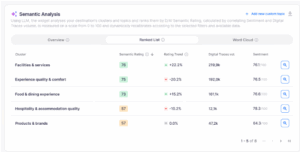
D / AI Destinations also offers Smart Insights — strategic recommendations generated by artificial intelligence based on your own reviews.
Smart Insights are a powerful tool designed to extract actionable knowledge from unstructured text reviews. Leveraging the capabilities of large language models (LLMs), they analyze thousands of reviews to deliver clear, personalized, data-driven suggestions — without the need to manually read each piece of feedback.
A real-life example: Milan’s family-friendly appeal
We activated the D / AI Destinations platform for the city of Milan and asked the AI to analyze user perception over the last few months regarding family services.
With the “Summary” function, we quickly pinpointed the strengths and weaknesses in this area.
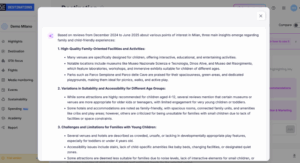
By analyzing all available reviews related to families, the AI concluded that Milan offers a wide range of attractions, particularly museums, parks, and interactive exhibits that engage children and provide educational fun.
However, there is variability in accessibility, especially concerning age appropriateness and suitability for very young children, highlighting the importance for families to plan visits based on their child’s specific needs and to verify the services offered by destinations and accommodations.
The most frequent criticism from families about Milan is that many public places lack essential services for those with infants: breastfeeding or sleeping areas, and limited access for strollers.
At the same time, there are attractions that are particularly appreciated by these travelers, such as the National Museum of Science and Technology, Dinos Alive, the Museum of the Risorgimento, Parco Sempione, and Parco delle Cave.
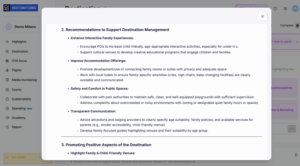
Going a step further, the platform also provides DMOs with practical recommendations for intervention. For example, increasing interactive experiences, ensuring safety, clarity in communication, cleanliness, and the availability of services for young children.
Want to try D / AI Destinations?