

Digital twin technology: What is it, and what is its impact across key industries?
Digital twins are reshaping industries like manufacturing, energy, transportation, and urban management. But what are they exactly? And how, and why are they gaining traction across the globe?
Artificial Intelligence
19 February 2025
In this blog, we’ll uncover the fundamentals of digital twin technology and explore its advantages and applications across different industries. We’ll also introduce Almawave’s solutions—SWMS (Smart Waste Management System) and SGMS (Smart Grid Management System)—that demonstrate its potential to drive smarter, more sustainable operations.
What is digital twin technology and how does it work?
Digital twins are, in essence, a virtual replica of a physical object, process, or system that updates in real-time. These replicas don’t just mimic appearances—they capture the behavior, performance, and conditions of the original, creating its digital counterpart.
The first digital twin (although not known as such at the time) can be traced back to the 1960s during NASA’s early experiments with spacecraft simulations. During the Apollo 13 mission, an oxygen tank explosion severely damaged the spacecraft, prompting engineers to rely on advanced simulations.
By integrating real-time data with a virtual representation of the spacecraft, they created an early version of what is now known as a digital twin. This approach allowed them to analyze the incident, reconstruct the failure, and develop solutions to bring the crew safely back to Earth.
Fastforward to today and the use of digital twins has skyrocketed. A McKinsey study revealed that nearly 75% of companies in advanced industries have already implemented digital twin technologies with at least a medium level of complexity.
It’s no wonder that Fortune Business Insights predicts the market is set to reach USD 259.32 billion by 2032.
And while this technology continues to evolve, there’s one question that’s still among the most frequently asked : are digital twins simply another form of simulation, or do they offer something more?
Is a digital twin the same as a simulation?
A digital twin isn’t the same as a simulation. In short, the main difference between the two is within the relationship they have with the real world, as well as their purpose.
- A digital twin is a real-time digital replica of a physical object, process, or system. It continuously receives data from the physical counterpart through sensors or IoT devices, reflecting its current state, behavior, and performance.
The purpose of a digital twin is to monitor, analyze, and optimize the physical entity it represents in real-time. It’s dynamic and continuously updated, providing actionable insights based on actual data.
- A simulation is a model-based replication of a system or process, designed to test different scenarios and predict outcomes. It is typically not connected to real-world data but instead relies on hypothetical inputs or predefined conditions.
The purpose of a simulation is to explore possible scenarios, experiment with different variables, and understand potential outcomes in a controlled environment.
Key benefits of digital twin technology
What are some of the most prominent advantages of employing digital twin technology?
- Improved operational efficiency
According to the same McKinsey study quoted above digital twins help reduce quality issues by 25% before production. By creating a virtual replica of physical assets or processes, digital twins allow for real-time monitoring and simulation of systems. This enables businesses to optimize operations, reduce downtime, and prevent issues before they arise.
- Predictive maintenance
Digital twins enable predictive analytics by analyzing data from physical systems. This helps anticipate maintenance needs, reducing unplanned downtime and extending the life of equipment.
The same McKinsey study also mentions how digital twins support predictive maintenance and performance optimization, boosting aftermarket service revenues by 5–10% in some product categories.
- Cost savings
Through optimization and predictive maintenance, digital twins can lead to significant cost savings by preventing expensive repairs and reducing inefficiencies in production or operations.
- Enhanced decision-making
With real-time data and the ability to simulate various scenarios, digital twins provide valuable insights that support better decision-making. This includes optimizing product designs, improving supply chain management, and enhancing operational strategies.
- Faster time-to-market
By simulating designs and processes before implementation, digital twins accelerate product development and testing. This reduces the time needed for trial and error and helps bring products to market faster.
- Improved product development
Engineers and designers can test products and prototypes virtually using digital twins, allowing for the identification of design flaws or inefficiencies before physical production, leading to better-quality products.
- Sustainability
Digital twins can help optimize resource usage, reduce waste, and lower energy consumption, making them valuable tools for businesses seeking to implement more sustainable practices.
- Real-time monitoring and control
With continuous data streaming from physical objects to their digital counterparts, businesses can monitor the status of systems in real time, allowing for quicker responses to any changes or issues.
- Customization and personalization
In consumer-facing sectors like tourism, digital twins can simulate customer preferences and behaviors, allowing for more personalized offerings and experiences.
- Integration of AI and IoT
Digital twins work seamlessly with AI and IoT technologies, enabling smarter automation and data-driven insights that can enhance both efficiency and innovation.
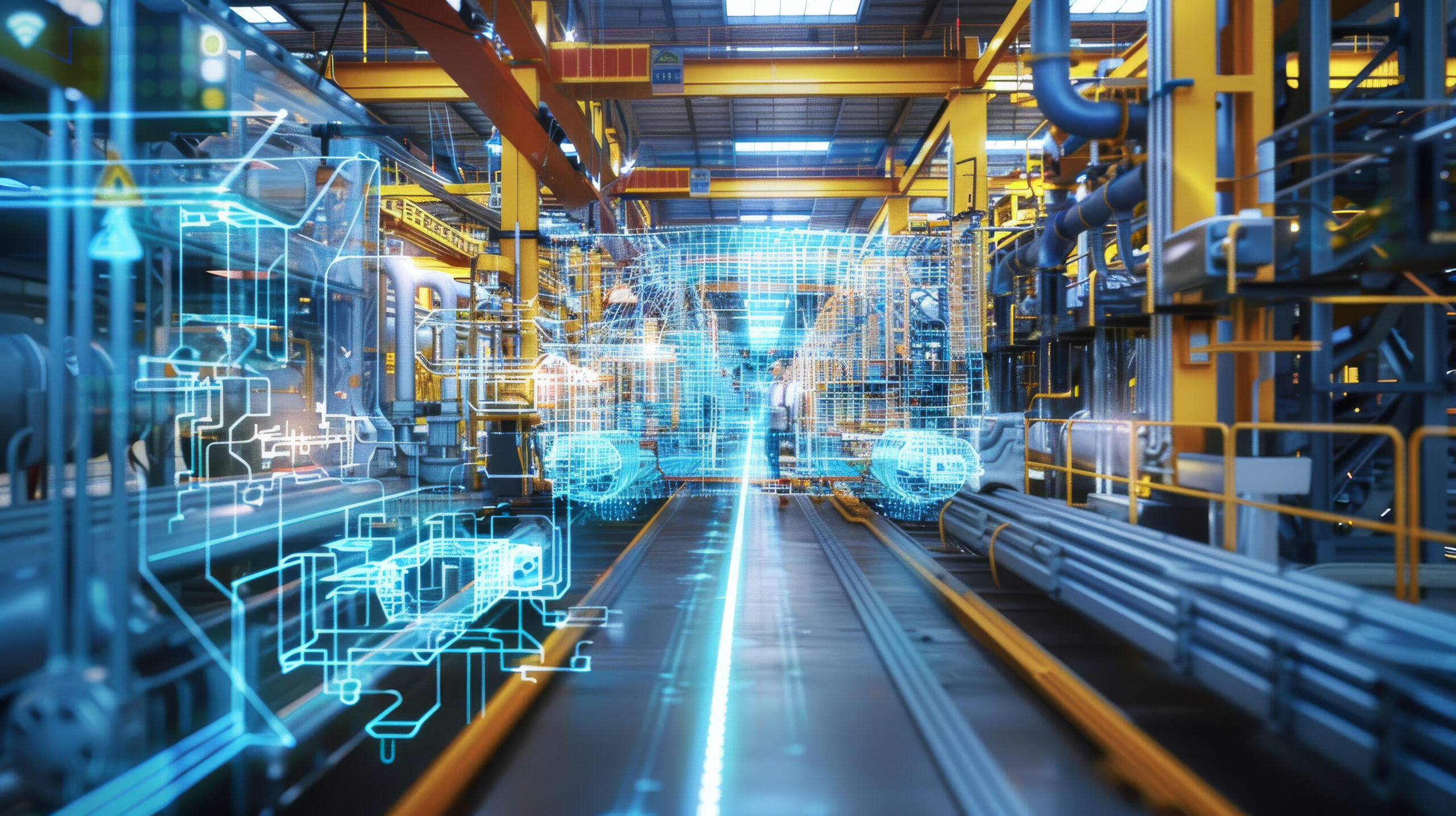
Digital twin technology applications across industries
Digital twin technology is disrupting various industries. The following are some of the sectors where it has already become crucial, alongside some of the most prevalent applications within each.
Manufacturing and industrial
In the manufacturing and industrial sectors, digital twins enable predictive maintenance by monitoring equipment performance and predicting failures before they occur. They also help refine production lines through simulations, reducing waste and improving efficiency, while tracking products throughout their lifecycle from design to disposal, promoting sustainability.
Healthcare and life sciences
In healthcare, digital twins of patients allow for personalized medicine by simulating treatments and predicting health outcomes. They also optimize the development of medical devices through simulations before production and improve hospital operations by enhancing facility management, patient flow, and resource allocation.
Construction and real state
In construction and real estate, Building Information Modeling (BIM) powered by digital twins helps architects and engineers create optimized designs. Real-time monitoring improves energy efficiency and maintenance for facilities, while AI-driven simulations of construction sites improve safety and workflow efficiency.
Automotive and aerospace
In the automotive and aerospace industries, digital twins simulate vehicle and aircraft performance, allowing for thorough testing and design before physical prototypes are built. They also enable AI-powered training for autonomous systems like self-driving cars and drones, while real-time monitoring of logistics fleets ensures better fuel efficiency and predictive maintenance.
Smart cities and urban planning
In smart cities, digital twins are used to monitor infrastructure, such as bridges, roads, and utilities, to detect wear and prevent failures. They also help with traffic and mobility planning by simulating traffic patterns to optimize transportation. Additionally, simulations are employed to enhance sustainability and energy efficiency, optimizing resource usage and reducing emissions.
Energy and utilities
In the energy and utilities sector, digital twins play a crucial role in grid optimization, balancing energy supply and demand in power grids. They also help manage asset performance by monitoring turbines, pipelines, and solar farms to predict maintenance needs. Additionally, digital twins are used to optimize renewable energy production by simulating wind and solar energy systems, integrating weather data for better forecasting. Smart water and gas management systems (SWMS and SGMS) are also integrated into the sector, offering solutions for efficient water and gas distribution, ensuring real-time monitoring and reducing wastage.
Almawave’s digital twin techonlogy: Smart Water Management System (SWMS) and Smart Gas Management System (SGMS)
Almawave provides two advanced digital twin solutions: the Smart Water Management System (SWMS) and the Smart Gas Management System (SGMS).
Smart Water Management System (SWMS): Enhancing efficiency and sustainability
Smart Water Management Systems use digital twin technology to provide a real-time overview of water networks, helping operators monitor infrastructure, detect leaks, and optimize distribution.
By integrating IoT sensors, GIS-based analytics, and predictive modeling, SWMS enhances water conservation efforts and improves service reliability. These systems allow for continuous monitoring of infrastructure, early detection of anomalies, and efficient coordination of maintenance activities.
Almawave’s Smart Water Management System manages extensive networks, supporting over 50,000 km of water infrastructure with 125,000 sensors. Clients benefit from advanced monitoring, including installations on 450,000 pipelines, over a million functional nodes, and 1.4 million smart meters. The system processes thousands of alerts and work orders annually, ensuring proactive maintenance, reducing water loss, and optimizing resource distribution.

Smart Gas Management System (SGMS): Optimizing safety and performance
Gas distribution networks face unique challenges in ensuring safety, preventing leaks, and maintaining operational efficiency. Smart Gas Management Systems leverage digital twins to provide real-time insights, allowing for predictive maintenance and remote monitoring.
By combining IoT telemetry, GIS-based mapping, and AI-driven analytics, SGMS helps utilities detect anomalies, prevent failures, and optimize network performance. These solutions integrate business intelligence tools to support decision-making and simulate ‘what-if’ scenarios using advanced mathematical models.
Almawave’s Smart Gas Management System supports major gas operators in Italy, facilitating digital transformation and enhancing the resilience of gas distribution networks. It provides a comprehensive framework for monitoring gas flow, identifying operational inefficiencies, and improving overall safety through automated control mechanisms.