




Breaking barriers at sea: Conversational AI and document automation in maritime operations

Artificial Intelligence
7 October 2025
The maritime industry operates in a fast-paced, global environment where smooth communication and efficient document handling are essential.
From coordinating with international ports to ensuring compliance with ever-changing regulations, maritime professionals face constant pressure to perform quickly and accurately. But with teams spread across different regions and languages, this can be a challenge.
Language barriers, slow document processing, and the time it takes to transcribe and translate information can slow down operations, create confusion, and even put compliance at risk. In such a high-stakes industry, these delays can have serious consequences.
However, the latest technologies are making century-old challenges easier to tackle. Undoubtedly, Conversational AI and document automation are among the most powerful solutions in the field.
By enabling real-time, multilingual communication and automating the processing and management of key documents, these technologies can help maritime teams respond faster, reduce errors, and stay on top of compliance requirements.
In this blog, we’ll explore how these advanced tools can streamline communication, boost operational efficiency, and ultimately make maritime operations run more smoothly and securely.
What is Conversational AI?
Conversational AI refers to a set of technologies that enable machines to engage in human-like conversations, whether through voice or text.
At its core, it combines speech recognition, natural language processing (NLP), and machine learning to understand and generate responses that feel natural and relevant to users.
Unlike traditional automation, which follows pre-defined instructions, Conversational AI can learn from interactions and adapt its responses over time.
It doesn’t just repeat set answers—it can understand the intent behind a user’s question, process complex language, and provide contextual, accurate answers or take appropriate actions.
Conversational AI brings machines closer to understanding the nuances of human communication, breaking down barriers of language and simplifying complex workflows. This makes this technology widely used in customer service, chatbots, virtual assistants, and any other application where real-time, interactive communication is needed. And makes it groundbreaking in the context of maritime operations.
What challenges does Conversational AI resolve in maritime operations?
Conversational AI resolves several key challenges faced in maritime operations.
One major issue is fragmented access to operational data, manuals, and guidelines. Traditionally, this information is scattered across multiple systems or physical documents, making it time-consuming for crews to locate what they need.
With Conversational AI, information is centralized and accessible through a simple interface, allowing crew members to quickly retrieve the necessary resources.
In high-pressure scenarios, where time is of the essence, the need for rapid and precise answers becomes critical. Conversational AI can provide instant, accurate information, enabling crews to make informed decisions quickly, without the delay of traditional methods like searching through manuals or waiting for expert input.
Another challenge is the need for multilingual and multimodal interaction. Maritime operations often involve crews from diverse linguistic backgrounds, and communication barriers can lead to costly mistakes or misunderstandings. Conversational AI can bridge these gaps by enabling seamless communication in multiple languages and through different formats, ensuring clarity and reducing the risk of errors.
Finally, in dynamic or hazardous environments, such as rough seas or confined spaces, hands-free operation is essential. With Conversational AI, crew members can interact with systems and access information without needing to physically manipulate devices, reducing distractions and improving safety in situations where manual intervention might be dangerous or impractical.
Benefits of Conversational AI in maritime operations
Conversational AI helps maritime operators overcome operational hurdles while delivering tangible advantages:
- Faster, more efficient communication: By handling multilingual conversations in real time, AI reduces delays caused by language barriers or slow manual responses.
- Improved accuracy and data capture: Key information from conversations—whether about incidents, cargo updates, or regulatory compliance—is extracted and recorded automatically, reducing errors.
- 24/7 availability: AI can interact with crews, port authorities, or stakeholders around the clock, ensuring critical communications are never missed.
- Reduced workload for staff: Routine queries, standard instructions, or repetitive reporting can be handled by AI, freeing human operators to focus on higher-priority tasks.
- Enhanced compliance and traceability: Every interaction can be logged, transcribed, and stored securely, providing a clear, auditable record for regulatory purposes.
- Seamless integration with operations: Conversational AI can feed structured data directly into document automation systems, creating a smooth flow from communication to actionable reporting.
What is AI documentation automation?
AI document automation is the use of artificial intelligence to automatically process, organize, and manage documents with minimal human intervention.
By combining natural language querying with specialized large language models (LLMs), operators can quickly retrieve relevant data and automatically generate fully compliant documents, eliminating the need for time-consuming manual drafting. This technology enables organizations to handle a wide variety of documents—such as invoices, contracts, reports, forms, and compliance records—efficiently and consistently.
By automating repetitive and error-prone tasks, AI document automation reduces operational bottlenecks, improves accuracy, and frees up human resources to focus on higher-value work. It also supports faster decision-making, better compliance, and more reliable record-keeping across industries where document volume and complexity are high.
What challenges does AI document automation resolve in Maritime operations?
Queries to naval databases often require a significant amount of technical knowledge and manual effort, making it a time-consuming and error-prone task.
This complexity can slow down the decision-making process and increase the risk of mistakes, particularly when operators need to access critical information quickly.
Similarly, drafting administrative documents manually is a labor-intensive process that is both slow and prone to human error, which can result in inaccuracies or delays.
Ensuring consistency and compliance with official formats is another challenge, as the documentation must adhere to strict standards that can be difficult to maintain without automated systems.
Furthermore, in maritime operations, traceability and auditability are crucial for accountability, especially when it comes to regulatory compliance or investigating operational discrepancies.
Without proper tools to track and verify changes, the risk of overlooking key details or failing to meet compliance requirements increases.
Benefits of AI document automation in maritime operations
AI document automation transforms the way maritime professionals handle paperwork, delivering clear operational advantages:
- Faster processing of documents: Automation speeds up the completion of reports, forms, and compliance documentation, reducing bottlenecks and enabling timely decision-making.
- Improved accuracy and consistency: AI ensures that information is captured correctly, formatted consistently, and free from human errors that could compromise compliance or operations.
- Regulatory compliance made easier: Automated systems help ensure all forms and reports meet local and international maritime regulations, lowering the risk of penalties or delays.
- Reduced administrative workload: Routine document preparation, data entry, and record-keeping are handled automatically, freeing staff to focus on operational priorities.
- Multilingual support: AI can process, transcribe, and translate documents across multiple languages, ensuring smooth communication and record-keeping for international crews and ports.
- Enhanced data traceability: Every processed document is logged and stored securely, creating an auditable trail that supports compliance, safety, and reporting requirements.
- Seamless integration with other systems: AI document automation can connect with Conversational AI and other operational tools, allowing information to flow smoothly from communication to structured documentation.
The power of combining Conversational AI with document automation
Individually, Conversational AI and document automation bring significant efficiencies, but together they create a seamless flow between communication and paperwork that transforms maritime operations.
Conversations with crew, port authorities, or passengers can be transcribed, analyzed, and converted into structured documents in real time, while follow-up actions—such as form-filling, report generation, and compliance documentation—are completed automatically.
This integration not only accelerates operations and reduces errors but also ensures that every interaction and document is securely logged for traceability and regulatory compliance. The result is a smoother, more accurate workflow that eases the workload for staff and creates a more efficient, reassuring experience for crews and passengers alike.
Integrating real-time transcription and multilingual translation
A critical component that strengthens this combination is real-time transcription and multilingual translation. By combining it with Conversational AI with document automation, maritime teams unlock a new set of benefits, including:
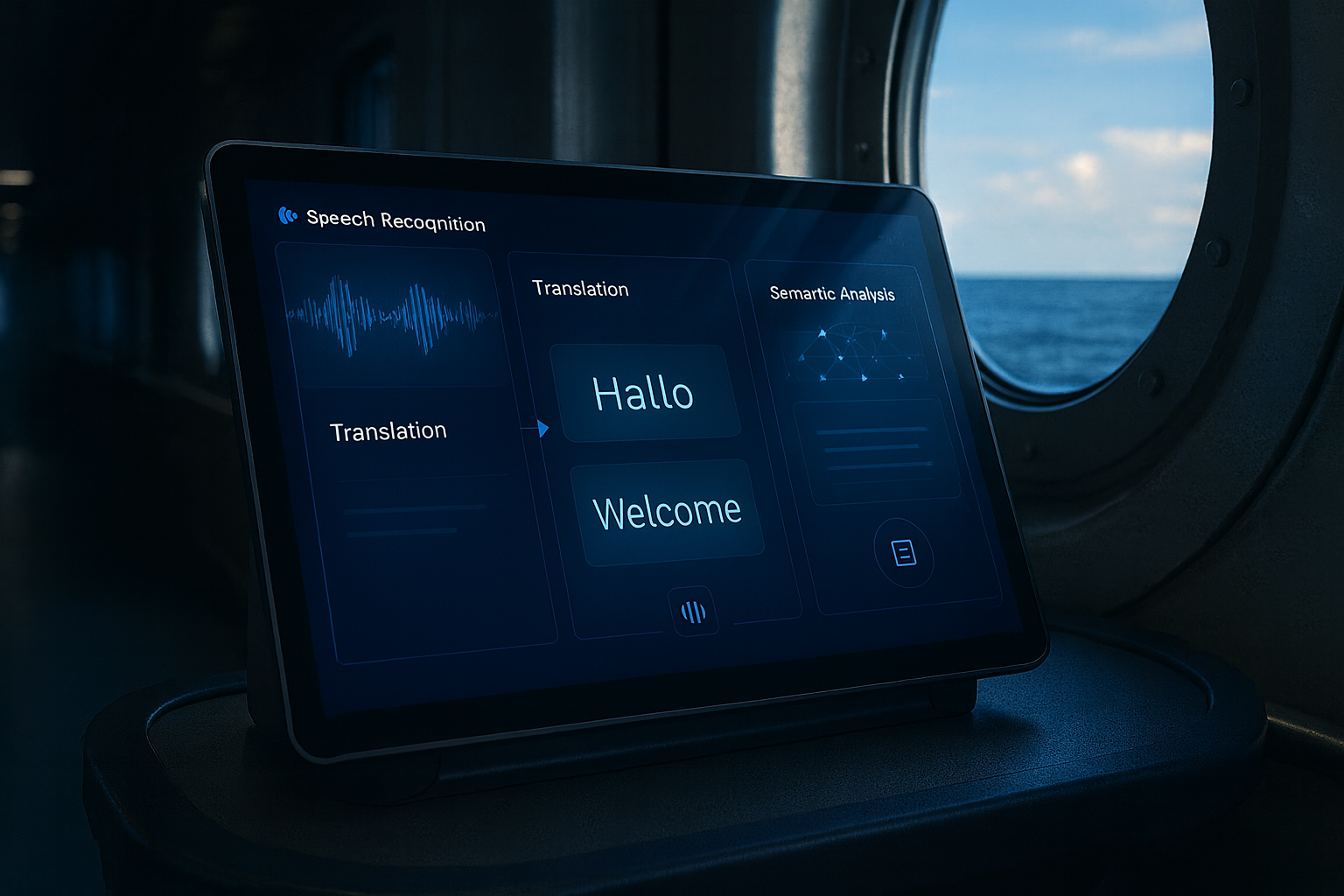
- Real-time multilingual voice recognition: Transcribes spoken language instantly into text, allowing crews to communicate effectively regardless of their language.
- Automatic translation to overcome language barriers: Translates conversations in real-time, ensuring smooth communication between diverse maritime teams.
- Semantic analysis to extract critical data from responses: Identifies key details from conversations to help operators make informed decisions quickly.
- Automatic form filling to assist operators: Automatically populates forms with relevant data, saving time and reducing manual errors.
- Simplified interface with suggestions, alerts, previews, and privacy by design: Provides an intuitive interface with real-time suggestions and alerts, while ensuring data privacy and compliance.
Key benefits for operators, organizations, and regulators
On the ground, maritime operators, organizations, and regulators all gain significant advantages from integrating Conversational AI with document automation.
Operators benefit from faster, more accurate communication, as multilingual interactions are transcribed, translated, and analyzed in real time. This enables them to respond swiftly and reduce human error, even in high-pressure situations.
Organizations experience enhanced operational efficiency, with reports, compliance forms, cargo manifests, and maintenance logs automatically generated and delivered. This automation frees up staff to focus on more critical tasks, improving overall productivity.
Regulators benefit from fully traceable and accurate records, with all interactions and documents securely logged for easy access. This streamlined process ensures compliance and simplifies audits, especially when dealing with international regulations.

Discover Almawave’s solutions
At the core, our Conversational AI solutions empower organizations to easily build and deploy conversational assistants using advanced technologies like Generative AI. With a no-code approach, businesses can quickly implement dialogue flows across multiple communication channels, enhancing user experience and operational efficiency while reducing development time and costs.
This is complemented by AI document automation, which retrieves structured data, auto-fills forms, and generates regulatory-compliant documents, reducing errors and saving valuable time.
To support real-time operations, Speech & Voice provides voice recognition, neural machine translation, and semantic data extraction, with optional human validation for sensitive cases—ensuring that critical information is captured and acted upon immediately.
Together, these solutions create a seamless ecosystem that streamlines communication, accelerates administrative workflows, and helps ensure compliance, improving operational efficiency across the maritime industry.
