





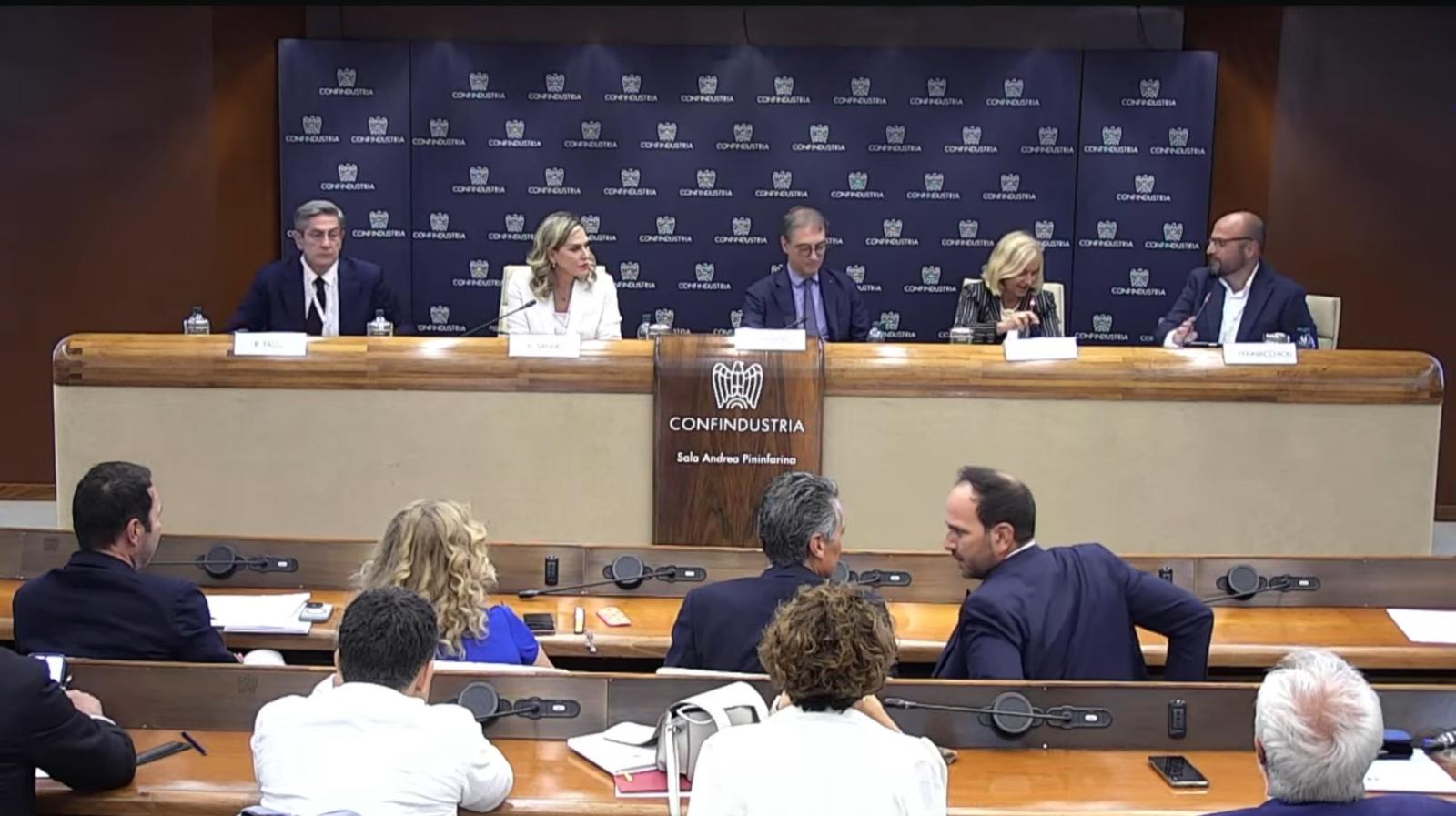
Valeria Sandei takes part in the event organized by CRUI and Confindustria
17 July 2025
“Today, sustainability is closely tied to the use of digital technologies—especially their conscious and responsible application,” said Valeria Sandei during the event “Industry and Universities: Together for Innovation”, organized by CRUI and Confindustria.
Speaking on the panel dedicated to the Twin Transition and moderated by Andrea Pennacchioli, journalist at La7, the CEO of Almawave joined Donatella Sciuto, Rector of Politecnico di Milano; Giovanni Molari, Rector of Alma Mater Studiorum – University of Bologna; and Roberto Tasca, President of A2A.
“Artificial intelligence is profoundly transforming all sectors and our economy,” Sandei noted. “For example, in the tourism industry, it is changing the way we interact and analyze information by enabling a geolocated understanding of data and traveler experiences. In healthcare, AI is a key challenge for building a more sustainable system and promoting collective well-being—through telemedicine and data analysis to support personalized, effective care.”
“AI applied to resource optimization is a core theme in sustainability. Take water management, for example: 40% of water resources are lost across the territory. Understanding where these leaks occur—and being able to predict them more accurately—is crucial.
All these examples show how digital technologies and artificial intelligence are central tools for sustainable development.”
“At the same time,” she added, “we must internalize the concept of sustainability in the very production of technologies. It’s essential to understand their impact in terms of energy and resource consumption: we must assess which purposes they truly serve, the benefits they bring, and the goals they are designed to achieve.
Sustainability must also guide the design and production of technologies that are created to solve real-world problems in specific sectors.”
“This applies especially to the development of artificial intelligence—and generative AI in particular—which must align with standards like ISO 42001 and regulations such as the AI Act. Sustainability becomes a key factor to consider.
How can we achieve this? By optimizing training processes, understanding what truly needs to be trained, on what scale, and for what purpose. These are interconnected aspects that must be seen as drivers of innovation—not as constraints on implementation—so we can stay aligned with the sustainability goals we set for ourselves.”
“These technologies are incredibly powerful tools, and the connection between universities, education, and industry is vital. This value chain must function effectively, but we also need to translate this transformation into concrete action—anchored in our sectors of reference and always keeping sustainability at the core,” Sandei concluded.